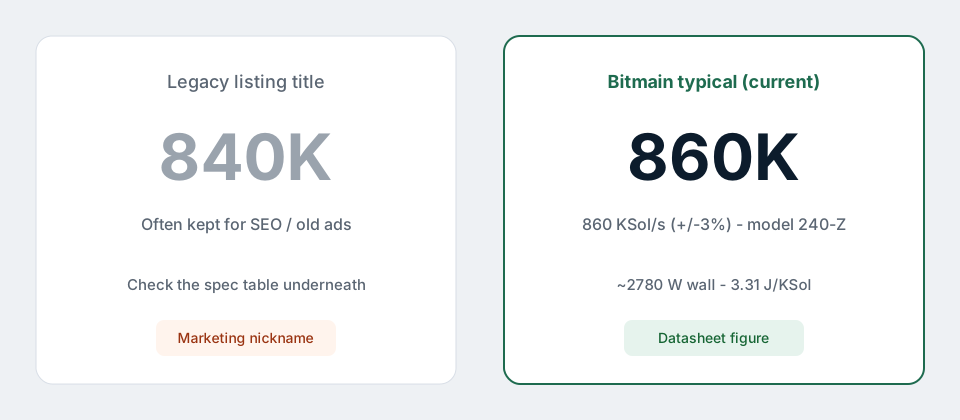
Search for Antminer Z15 Pro and the results split into two camps. Some shops still lead with 840 KSol/s. Others, including Bitmain’s own support pages for the current Z15 Pro, talk about a typical 860 KSol/s unit (model line 240-Z). Buyers reasonably ask whether those are two different miners.
Most of the time, they are not. What you are looking at is a naming hangover from older marketing, mixed with how retailers recycle product titles.
What Bitmain publishes for the current Z15 Pro
For the Z15 Pro that people buy today as an 860K-class machine, Bitmain Support style figures look like this at about 25°C ambient:
- Typical hashrate: 860 KSol/s (±3%)
- Wall power: 2780 W (±5%)
- Efficiency: about 3.31 J/KSol (±5%)
- Algorithm: Equihash (ZEC / ZEN and other Equihash pools where supported)
Those are the numbers we put on our product specs. If a listing still says 840K but quotes 2780 W and 3.31 J/KSol, it is usually the same generation of hardware with a stale title.
So where did “840K” come from?
Early Z15 Pro chatter and some reseller pages settled on 840K as a round marketing figure. Pages do not always get updated when Bitmain’s published typical hashrate moves. Affiliate tables, marketplace clones, and translated ads keep the old label because it already ranks in Google.
There is also a habit in ASIC retail of leaving the SKU name alone even when the datasheet is refreshed. The box in the warehouse may be a current 860K-rated Z15 Pro while the HTML title still says 840K for search traffic.
That does not mean every 840K advert is honest. It means you should read the spec table, not only the headline.
How to tell what you are actually being sold
Before you pay, check four things:
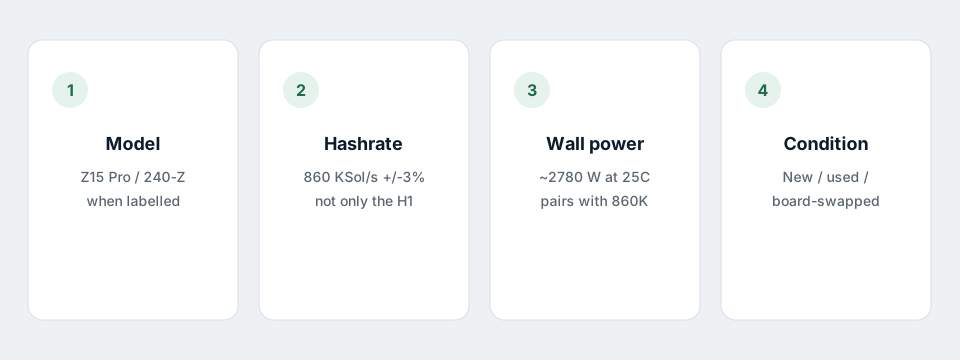
- Model / version — look for Z15 Pro and the 240-Z style identifier when the seller provides it.
- Hashrate band — 860 KSol/s ±3% is the current Bitmain typical figure we follow.
- Wall power — ~2780 W at 25°C is the paired power number. Listings that still show much lower wattage from older write-ups deserve a question.
- Condition — new vs used vs “hashboard swapped”. Used units can be honest 840K talk if they were configured or throttled differently; new sealed stock should match current Support data.
If a seller cannot say whether the unit is new Bitmain stock or a refurbished board set, walk away. The 840K/860K label is the least of your problems at that point.
Does 20 KSol/s matter?
On paper, 860 vs 840 is a little over 2%. In a tight margin market that is not nothing, but it will not rescue a bad power rate. Electricity and uptime dominate the spreadsheet. Use a live profitability site for revenue, then subtract roughly 66.7 kWh/day at 2780 W continuous — see our ROI calculator.
What does matter is buying on false expectations. If you budgeted for 860K and receive a machine that only holds 780K because of heat, bad firmware, or a tired used unit, that is a different issue than the marketing title on a product card.
What we sell
We list the miner as Antminer Z15 Pro 860K because that matches the Bitmain Support figures we publish. We do not pretend older “840K” ads were a separate SKU we secretly stock. If you open an old forum thread from years ago, expect the language to lag the datasheet.
Quick checklist before checkout
- Title says 840K or 860K? Fine — read the hashrate and wattage underneath.
- Confirm 200–240 V power plan (see our power & wiring guide).
- Ask for model labelling / batch notes if the price looks too good.
- Ignore anyone promising Bitcoin mining on a Z15 Pro. Wrong algorithm.
Bottom line: treat “840K” in search results as a legacy phrase unless the seller’s detailed specs disagree with Bitmain’s current 860K typical rating. Buy the machine described in the datasheet, not the one described in the leftover H1.
Next: How to set up Z15 Pro 860K · Power & wiring · All guides